Why every growing B2B business in India needs a CRM built for pipeline tracking
The businesses that scale aren't the ones with the biggest sales teams — they're the ones with the clearest visibility into their pipeline.
The problem most Indian SMEs don't talk about
Ask any founder or sales head at a mid-sized B2B company in India how their pipeline is tracked, and you'll often hear some version of the same answer: "It's in a spreadsheet, WhatsApp chats, and a few people's heads."
That's not a criticism — it's how most businesses start. But as deal volume grows, this informal system starts costing real money. Leads go cold because no one followed up on time. Two salespeople chase the same account. A founder finds out a big deal fell through only after it's already lost.
A CRM built specifically for B2B marketing and sales pipeline tracking solves exactly this — and it doesn't need to be a bloated enterprise tool to do it.
What this kind of CRM actually does
Unlike generic contact managers, a CRM designed around pipeline tracking focuses on three connected things.
Lead capture and qualification
Pulling in leads from LinkedIn, web forms, referrals, and cold outreach, and scoring them so sales time goes to the right accounts first.
Pipeline visibility
A clear, stage-by-stage view of every deal, so nothing sits untouched without anyone noticing.
Marketing-to-sales handoff
Connecting campaign activity — ads, email, events — directly to the deals they generate, so spend ties to revenue instead of vanity metrics.
The real benefits
Nothing falls through the cracks
Every lead and deal has an owner, a stage, and a next action. Follow-ups happen because the system prompts them — not because someone remembered.
Founders get a real-time view without chasing updates
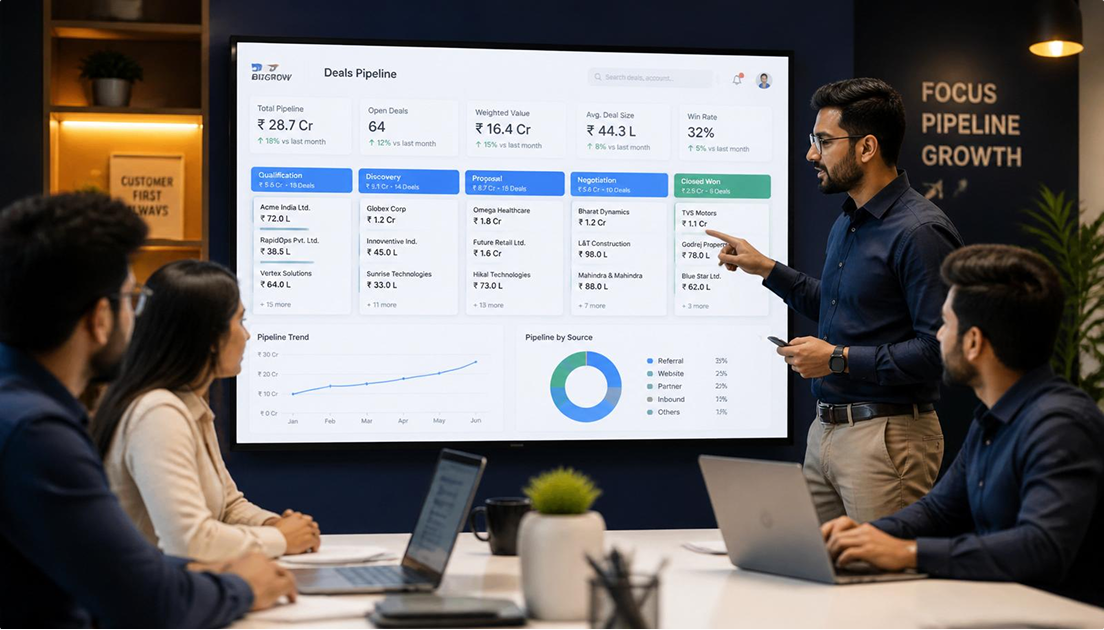
Instead of asking "where are we with that account?" in a Monday meeting, a founder or sales head can see pipeline value, stage-wise conversion, and stuck deals at a glance.
Marketing spend becomes accountable
When leads are tagged by source, it becomes possible to say clearly: "This LinkedIn campaign generated ₹18L in pipeline" instead of just "we got 40 leads." This is the single biggest gap most Indian SMEs have today — spend without attribution.
Faster onboarding for new sales hires
A documented pipeline with clear stages means a new salesperson can understand the process and get productive in days, not months — critical for small teams where one hire's ramp-up time matters a lot.
Better forecasting, fewer surprises
Weighted pipeline value (deal size × stage probability) gives a realistic forecast instead of gut-feel projections — useful for cash flow planning, hiring decisions, and investor conversations.
Built for how Indian B2B sales actually works
Multi-decision-maker buying committees, WhatsApp as a primary channel, long relationship-driven sales cycles, GST-aware invoicing hooks — a CRM designed with the Indian B2B context in mind fits the way deals are actually won here, rather than forcing a Western SaaS sales motion onto a very different buying culture.
Who this is actually for
This isn't a tool only for "tech companies." It's relevant to any business where deals involve multiple touchpoints, more than one decision-maker, and a sales cycle longer than a single transaction. That covers a wide range of Indian B2B businesses:
The common thread: if your sales process involves more than one conversation and more than one person on either side of the table, a pipeline-first CRM turns a chaotic process into a repeatable one.
Starting in India, built to scale globally
This CRM is launching first in the Indian market, purpose-built around how Indian B2B sales and marketing teams actually operate — relationship-first selling, multi-channel outreach across LinkedIn, WhatsApp, email and referrals, and the realities of SME team sizes and budgets.
The India-first approach isn't a limitation — it's a deliberate choice to get the product right where the buying behaviour is most nuanced, before expanding globally within the market. Lessons learned from real Indian sales cycles — long consideration periods, committee-based decisions, price sensitivity — will shape a product that's genuinely useful anywhere B2B selling happens, not just a generic CRM with a new logo.
The bottom line
Every growing B2B business eventually hits the same wall: the founder's memory and a spreadsheet stop being enough. The businesses that scale past that wall aren't the ones with the biggest sales teams — they're the ones with the clearest visibility into their pipeline.
A CRM built specifically for B2B pipeline tracking isn't overhead. It's the difference between growing on purpose and growing by accident.